Living in Athens
Living in Athens: neighbourhoods, cost of living and expatriation
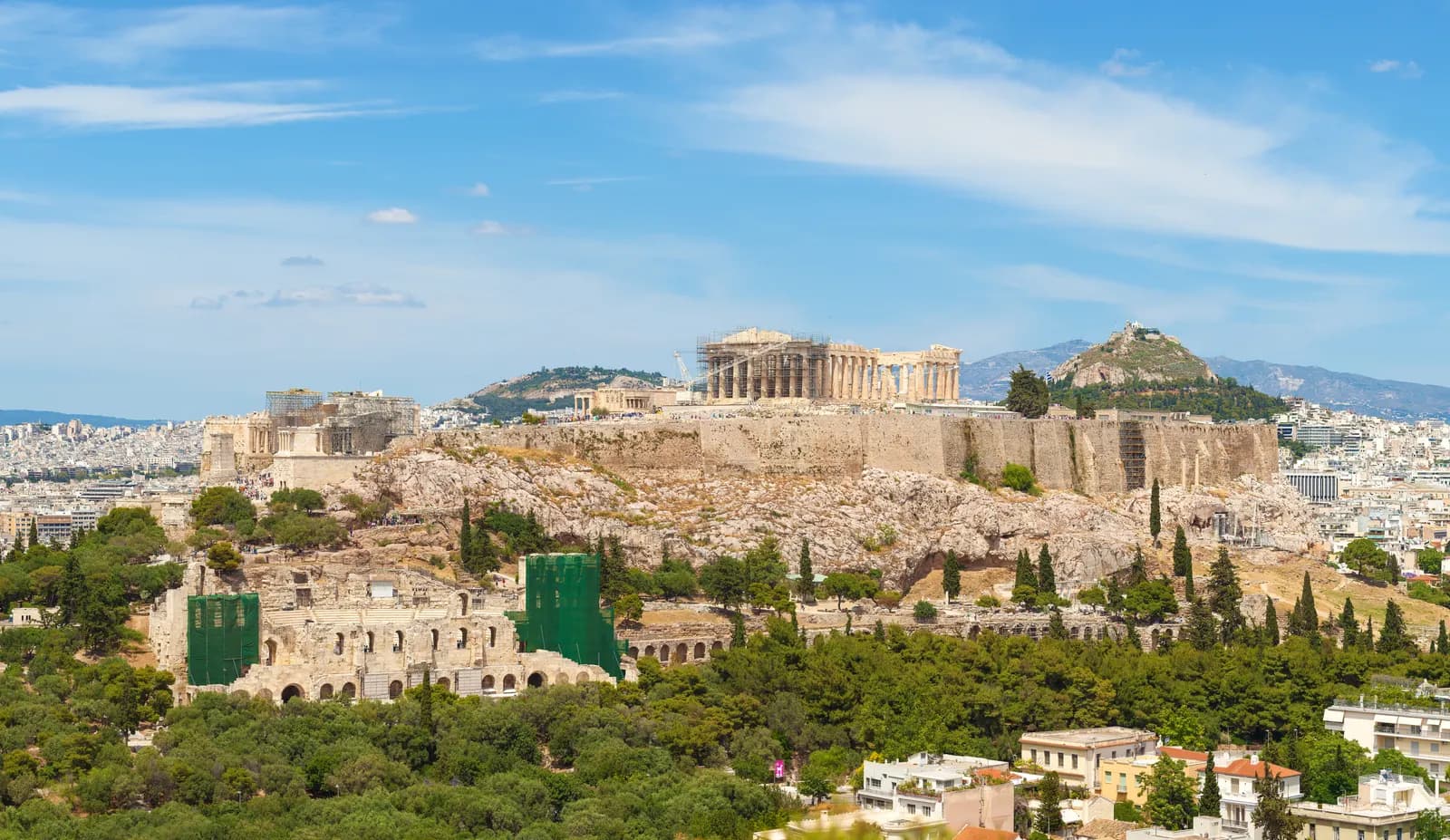
The cradle of European civilisation, Athens combines one of the lowest costs of living among EU capitals, an exceptional climate and a seaside Riviera on the city's doorstep. A favoured choice for retirees (7% regime) and digital nomads.
- Country
- Greece
Key figures
- Population3,600,000
- Rent, 2-room flat (centre)about€600
- Single-person budgetabout€2,000
- Flight from Parisabout3 hoursVerified on Nov 2, 2026
Where to live: the neighbourhoods
Athens is a sprawling metropolitan area, backed by four mountain ranges and open to the Saronic Gulf in the south. Its geography shapes everything: the north is green and residential, the south maritime, the centre dense and built-up.
The centre — Plaka, Monastiraki, Psyrri, Exarchia — mixes tourist districts with working-class neighbourhoods undergoing rapid change. Housing there consists mostly of post-war apartment blocks, often uninsulated, and family life is not very convenient.
Kolonaki and Pangrati form the central residential core: shops, schools and immediate proximity to Mount Lycabettus and the Panathenaic Stadium. They are the most expensive neighbourhoods in the centre and the most sought after by foreign newcomers.
The northern suburbs — Kifissia, Marousi, Chalandri — are home to most of the international schools, company headquarters and more spacious housing. They are the dominant choice for expatriate families, at the cost of reliance on the metro or a car.
The southern Riviera — Glyfada, Voula, Vouliagmeni — runs along the sea for some fifteen kilometres and attracts an affluent international clientele. The major redevelopment project at the former Elliniko airport has pushed prices up sharply there, and continues to do so.
Housing: the rental market
We do not publish a median rent for Athens: we have not found an official Greek data series publishing rents by neighbourhood or municipality, and we do not use estimates from listing portals, which are not official sources.
The defining feature of the Athens market is the reversal of the past decade. After prices collapsed during the debt crisis, the market saw one of the fastest increases in Europe, driven by tourism, short-term rentals and foreign investment.
The Greek residency by investment scheme for real estate has contributed to this trend. Its thresholds were raised by Law 5100 of 2024: the required investment is now €800,0005 in Attica, Thessaloniki and the most populated islands, compared with from €400,0006 in the rest of the country.
As Athens is in Attica, the highest threshold applies there, compared with from €250,0007 before the reform. The increase was designed specifically to ease the pressure on housing in the capital.
In practice, newcomers still find rents lower than in Western Europe, but in a housing stock with poor thermal performance. Checking the heating, insulation and hot water system should come before signing.
Cost of living
Athens remains one of the least expensive capitals in the eurozone for eating out, services and public transport. Food and energy, on the other hand, are closer to average European levels.
We do not publish a typical monthly budget: we have not found an official Greek data series measuring a basket of expenses comparable to that of an expatriate.
Energy is the trickiest item. The older housing stock is poorly insulated, the Athenian summer is very hot and long, and the winter colder than the latitude suggests. Air conditioning and heating costs add up over the year.
Greek salaries are among the lowest in the eurozone, which widens the gap between a household living on foreign income and one dependent on the local job market. The city is very affordable for the former, difficult for the latter.
The Greek income tax scale starts at 9%8 on the first bracket of salaries and pensions, which keeps entry-level taxation moderate for low and middle incomes.
Community & expat life
The international community in Athens has grown since the end of the crisis, with very different profiles: retirees from northern Europe, remote workers, property investors and staff of international organisations.
Two tax regimes account for part of these arrivals. The one for foreign retirees applies a flat rate of 7%9 on foreign-source income for 15 years10.
The one for high-net-worth individuals is based on an annual flat tax of €100,00011 on foreign income, combined with a required investment in Greece of €500,00012. The two schemes are separate and cannot be combined.
The Greek alphabet is the first practical barrier, more than the language itself: signage and administrative documents assume you can read it. English, on the other hand, is widely spoken in the capital.
Practicalities: transport, health, good to know
The Athens metro has three lines, complemented by a tram to the southern Riviera and a dense but slow bus network. The network is efficient along its routes and non-existent elsewhere: location relative to a station is decisive.
The airport is connected to the centre by metro and motorway. It offers good European connections and is the gateway to the islands, by plane as well as via the port of Piraeus.
The Greek public health system suffered during the austerity years and waiting times are long; private healthcare in Athens, on the other hand, is well developed and of a good standard. Private insurance is the norm among expatriates.
- The Greek tax number is required for the lease, the bank account and utility contracts: get it first.
- The thermal performance of your home is a major financial criterion, not a mere comfort detail.
- Presence of more than more than 183 days13 triggers Greek tax residency.
- Both incentive regimes require a formal application within the prescribed deadlines: they do not apply automatically.
Frequently asked questions
What budget do you need to live in Athens?
Where to live by the sea near Athens?
The Athens Riviera: Glyfada, Voula and Vouliagmeni, residential areas close to the international schools.
Does the 7% retiree regime apply in Athens?
Yes, it applies throughout Greece to eligible foreign retirees who transfer their tax residency there.
Sources and verification dates
- 1.
Population : 3,600,000
- 2.
Rent, 2-room flat (centre) : €600
- 3.
Single-person budget : €2,000
- 4.
Flight from Paris : 3 hours
Verified on Nov 2, 2026
- 5.
Greece, Golden Visa: real estate investment threshold in Attica, Thessaloniki, Mykonos, Santorini and populous islands : €800,000
« αυξάνεται το όριο ελάχιστης επένδυσης σε ακίνητα... από 500.000€ σε 800.000€ »
stegasi.gov.grVerified on Nov 2, 2026Verified source
- 6.
Greece, Golden Visa: real estate investment threshold in the rest of the country : €400,000
« αύξηση από 250.000€ σε 400.000€ »
stegasi.gov.grVerified on Nov 2, 2026Verified source
- 7.
Greece, Golden Visa: former threshold in the rest of the country, before law 5100/2024 : €250,000
« αύξηση από 250.000€ σε 400.000€ »
stegasi.gov.grVerified on Nov 2, 2026Verified source
- 8.
Greece: rate of the first bracket of the salaries and pensions scale (from 2026) : 9%
« For tax years 2026 onwards, taxable income from employment and pension is taxed according to the following scale — Income (€) / Tax Rate : 0 – 10.000 : 9% ; 10.001 – 20.000 : 20% ; 20.001 – 30.000 : 26% ; 30.001 – 40.000 : 34% ; 40.000,01 – 60.000 : 39% ; > 60.000 : 44% [taux réduits selon le nombre d'enfants à charge]. — Ministry of Economy and Finance, « Tax Guide – Income Taxation » (Law 4172/2013, Income Tax Code). »
minfin.gov.grVerified on Nov 2, 2026Verified source
- 9.
Greece, regime for foreign retirees: flat rate on foreign-source income : 7%
« Annual flat tax rate of 7% on total foreign source income. »
enterprisegreece.grVerified on Nov 2, 2026Verified source
- 10.
Greece, regime for foreign retirees: period of application : 15 years
« Duration of regime's applicability • Fifteen (15) tax years. »
enterprisegreece.grVerified on Nov 2, 2026Verified source
- 11.
Greece, regime for high-net-worth individuals: annual flat tax on foreign income : €100,000
« 1.2 Special tax regimes at a glance — HIGH NET WORTH INDIVIDUAL (HNWI) REGIME : Not a Greek tax resident for the seven (7) out of eight (8) years preceding the transfer to Greece. […] Minimum investment of EUR 500 000 within a period of three (3) years. […] Preferential alternative taxation : A lump sum tax of EUR 100 000 on an annual basis (extinguishing tax liability on global foreign source income). Plus a lump sum tax of EUR 20 000 on an annual basis, in case a relative (spouse, children, parents) utilizes respective provisions. Duration of regime's applicability : Fifteen (15) tax years. — Enterprise Greece, « Brief Tax Guide Greece 2026 » (art. 5A du Code des impôts sur le revenu). »
enterprisegreece.grVerified on Nov 2, 2026Verified source
- 12.
Greece, regime for high-net-worth individuals: investment required in Greece : €500,000
« HIGH NET WORTH INDIVIDUAL (HNWI) REGIME : […] Can prove that they or their relatives or a legal entity in which they hold the majority of the shares, invests in real estate or moveable assets or shares of legal entities based in Greece. Minimum investment of EUR 500 000 within a period of three (3) years. — Enterprise Greece, « Brief Tax Guide Greece 2026 » (art. 5A). »
enterprisegreece.grVerified on Nov 2, 2026Verified source
- 13.
Greece: annual presence above which tax residency is acquired : 183 days
« An individual is considered Greek tax resident if she/he maintains permanent or main residence or usual abode or center of vital interests in Greece […]. Furthermore, subject to the above provisions, any individual who is present in Greece for a period exceeding 183 days, cumulatively during any twelve (12) month period, is considered to be a Greek tax resident as of her/his first day of arrival in Greece. However, respective provisions are not applicable in case of individuals who are present in Greece only for tourism, medical, medicinal or equivalent personal purposes on condition that their presence does not exceed the 365 days threshold. — Enterprise Greece (agence publique d'investissement, ministère des Affaires étrangères), « Brief Tax Guide Greece 2026 » (Code des impôts sur le revenu, loi 4172/2013, art. 4). »
enterprisegreece.grVerified on Nov 2, 2026Verified source
- 14.
grece.immobilier.eur.1000 : €1,000