International mobility news

Bahrain

Moving to Bahrain in 2026: zero tax and the Gulf's more open setting

Bahrain levies no income tax and has a reputation as a more open and liberal setting than its Gulf neighbours. A lower cost of living than Dubai and accessible residency make it a credible alternative.

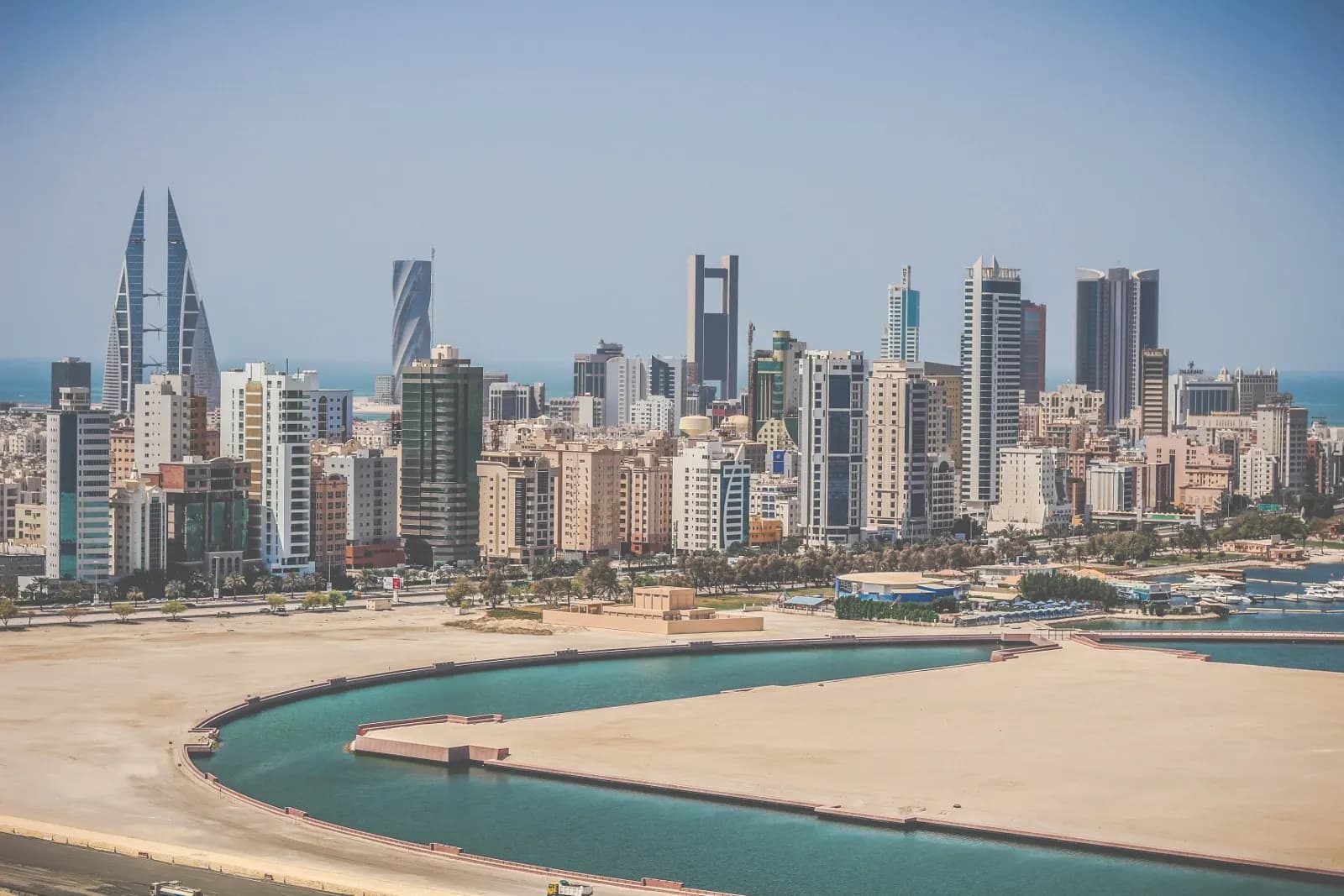
View of Bahrain
Photo: Wadiia — Wikimedia Commons (CC BY-SA)
Capital
Manama
Currency
BHD
Region
Middle East

Key figures

  • Population1,500,000Verified on Nov 2, 2026
  • Flight from Parisabout6 hoursVerified on Nov 2, 2026

Personal taxation

Among the Gulf states, Bahrain is the one whose administration states its position most clearly: there is no general taxation of personal or corporate income, nor any withholding tax. The applicable rate is 0%3 for individuals and 0%4 for companies.

This absence has one historical exception, the hydrocarbons sector, which is subject to its own regime. A global minimum tax has also been introduced for multinational groups within its scope, which marks the end of the principle's absolute character.

In return, value added tax has applied at a standard rate of 10%5 since 1 January 2022. The tax burden has therefore shifted from income to consumption — and its rate has doubled since it was first introduced.

This trajectory is instructive: Bahrain was the first Gulf state to introduce value added tax, then the first to double its rate. For a long-term plan, it indicates the general direction of public finances in the region.

For a French national, the rule remains unchanged: the absence of local tax does not end French tax domicile. As long as the household or the centre of economic interests remains in France, Article 4 B of the French General Tax Code (code général des impôts) continues to apply.

We do not publish the conditions for issuing a Bahraini tax residency certificate, nor the residence criteria used by local law: they do not appear in the sources we have been able to consult. Yet this is the document on which the application of any tax treaty depends.

Residence routes and visas

Residence in Bahrain has traditionally relied on sponsorship by an employer. The country has, however, opened an independent route based on property ownership, administered by the national authority regulating residence.

This so-called self-sponsorship residence permit is open to foreigners who own a property in Bahrain, provided that the value of the property is not less than BHD 50,0006, or approximately about $132,0007.

The threshold is remarkably low compared with similar schemes in the Gulf: it is an order of magnitude below that of the Emirates or Qatar. This is the main argument for the Bahraini scheme, and it explains the interest it attracts from more modest profiles than the usual golden visa clientele.

A separate scheme, known as the Golden Visa, also exists for long-term residents, investors and talent, with its own conditions regarding income and length of prior residence.

The conditions of the Bahraini Golden Visa — income thresholds, length of prior residence required, duration of the permit granted — do not appear in our extracts: they must be checked with the competent authority.

As elsewhere in the region, a permit obtained through the real estate route requires the property to be retained: selling it would have consequences for the right of residence.

It is important to grasp what this low threshold implies. A residence permit based on a property of this value is not aimed at the same public as the Emirati schemes: it makes the Gulf accessible to middle-sized estates, which is unusual in the region. But it confers neither the right to work locally without a separate authorisation, nor access to nationality, which remains closed.

It is therefore a residence permit, and nothing more. Its value should be judged on what it allows — living there, sponsoring one's family, opening an account — and not on a prospect of permanent settlement that Bahraini law does not offer.

Real estate

Freehold ownership is open to foreigners in designated areas, as in most neighbouring countries. Outside these areas, purchase is not possible.

The market is concentrated in a few developments designed for international buyers, mainly on artificial islands and in Manama's business districts. Supply is more limited than in Dubai, and the number of developers is small.

The narrowness of the market has a direct consequence for liquidity: resale depends on a small pool of buyers, made up of Gulf expatriates and nationals of the region. A property bought at the residence permit threshold is mainly resold to an applicant for the same scheme.

One feature specific to Bahrain is worth noting: the country is linked to Saudi Arabia by a causeway, and part of the property demand comes from residents working or living on either side. This dependence on its neighbour is a market factor in its own right.

We do not publish Bahraini registration fees, service charges or the list of areas open to foreign ownership: they do not appear in our sources.

Cost of living

Bahrain is reputed to be the least expensive Gulf state for a foreign resident, with housing and daily life considerably more affordable than in Dubai or Doha.

We do not publish a typical monthly budget: we have not found an official Bahraini series measuring a basket of expenses comparable to an expatriate's.

Three items shape a budget. Housing, more affordable than in neighbouring countries but concentrated in a few areas. International schooling, a major item for families. And health insurance, now mandatory for residents.

Value added tax at 10%5 weighs on all everyday consumption, which brings the real cost closer to that of neighbouring countries despite lower rents.

As everywhere in the Gulf, the climate requires air conditioning for much of the year and severely limits outdoor life for several months. This is a quality-of-life factor that financial comparisons leave out.

Procedures and timeframes

  1. Determine the route: sponsorship by an employer, self-sponsorship through property ownership, or Golden Visa;
  2. check that the target property is located in an area open to foreign ownership and that it reaches the required threshold;
  3. obtain the permit and then the identity card, which is required to open a bank account;
  4. take out the mandatory health insurance;
  5. handle the departure from France according to its own criteria, bearing in mind that the local tax residency certificate will have to be obtained separately.

The second point determines everything else: a property located outside an open area cannot be purchased, and a property bought below the threshold confers no right of residence. Verification comes before commitment.

We do not publish processing times: we have no official, quantified and dated source for Bahraini permits.

Points to watch

  • The absence of direct taxation is stated by an official source, but it already has exceptions — hydrocarbons, the global minimum tax.
  • Value added tax has doubled since its introduction: the trajectory of the levy points in one direction.
  • The self-sponsorship threshold of BHD 50,0006 is the lowest in the Gulf, but it requires a property located in an open area.
  • Liquidity in the property market is low and depends partly on Saudi demand.
  • A permit obtained through the real estate route requires the property to be retained.

Finally, Bahrain occupies a particular position in the Gulf: more socially open than its neighbours, less expensive, but also more economically dependent on them and less endowed with resources. For an expatriate, it is a destination where the entry cost is modest and the quality of life real; for an investor, it is a narrow market whose depth does not compare with Dubai's, and whose value largely depends on decisions taken elsewhere.

Pros and cons

Pros

  • 0%4 income tax, a more relaxed society than its neighbours

  • Lower cost of living than Dubai or Doha

  • Linked to Saudi Arabia by a bridge (regional market)

Cons

  • VAT of 10%5, smaller economy

  • Periodic regional tensions

  • Extreme summer

  • Permit dependent on real estate

Frequently asked questions

Is there an income tax in Bahrain?

No, there is no personal income tax.

Is residency accessible?

Yes, through employment, investment or dedicated residence programmes.

Is the cost of living lower than in Dubai?

Generally, yes.

Residence and citizenship by investment programmes

Data shared with the comparison tool: same amounts, same sources. Compare with other programmes

Self-sponsorship residence permit for foreign property owners

Residence · Open · Official page

Minimum entry
  • from BHD 50,000 — investment, main applicantValue shown on the title deed; also open to retirees and foreign investors (no amount published)bahrain.bh · Verified on Nov 2, 2026
Government fees (main applicant)
  • BHD 5 — government fees, main applicantNon-refundablebahrain.bh · Verified on Oct 13, 2026
  • BHD 200 — government fees, main applicant2-year permit; currency not shown on the page (BHD assumed)bahrain.bh · Verified on Oct 13, 2026
  • BHD 400 — government fees, main applicant5-year permit; currency not shown on the page (BHD assumed)bahrain.bh · Verified on Oct 13, 2026
  • BHD 600 — government fees, main applicant10-year permit; currency not shown on the page (BHD assumed)bahrain.bh · Verified on Oct 13, 2026
Family
Not provided
Processing time
  • about 40 days — processing time, main applicantWorking days; official estimate, not guaranteedbahrain.bh · Verified on Nov 2, 2026
Required stay
Not provided
Permit duration
  • up to 10 years — permit duration, main applicantPermits of 2, 5 or 10 years, as chosenbahrain.bh · Verified on Nov 2, 2026

Golden Residency Visa

Residence · Open · Official page

Minimum entry
  • from BHD 130,000 — investment, main applicantProperty in Bahrain; threshold lowered by the NPRA (press release of 26/11/2025); the official portal still shows the former thresholdkyodonewsprwire.jp · Verified on Oct 13, 2026
Government fees (main applicant)
  • BHD 5 — government fees, main applicantNon-refundablebahrain.bh · Verified on Oct 13, 2026
  • BHD 300 — government fees, main applicantIssuance fee for the 10-year permit, main applicantbahrain.bh · Verified on Oct 13, 2026
Family
Not provided
Processing time
  • about 5 days — processing time, main applicantWorking days; official estimate, not guaranteedbahrain.bh · Verified on Nov 2, 2026
Required stay
Not provided
Permit duration
  • 10 years — permit duration, main applicantDuration inferred from the name of the fee; the portal does not otherwise specify itbahrain.bh · Verified on Nov 2, 2026

Banks and accounts

Banks and accounts for this country

See this country on the tax map

Please note

General information, as of the date shown. A draft reform is not a rule in force: check the conditions with the authorities or a professional before deciding. Terms of use and disclaimers

Sources and verification dates

  1. 1.

    Population : 1,500,000

    Verified on Nov 2, 2026

  2. 2.

    Flight from Paris : 6 hours

    Verified on Nov 2, 2026

  3. 3.

    Bahrain: general personal income tax : 0%

    « Currently, there is no general taxation on the personal income of individuals or corporations and no withholding taxes, and no estate or gift taxes in Bahrain. — Kingdom of Bahrain, « Information on Residency for tax purposes », fiche officielle déposée par le Royaume auprès de l'OCDE (portail CRS). »

    oecd.orgVerified on Nov 2, 2026Verified source

  4. 4.

    Bahrain: general corporate income tax : 0%

    « Currently, there is no general taxation on the personal income of individuals or corporations and no withholding taxes, and no estate or gift taxes in Bahrain. — Kingdom of Bahrain, « Information on Residency for tax purposes » (OCDE). Exceptions : sociétés pétrolières et gazières (46 %) et, depuis le 1er janvier 2025, groupes multinationaux ≥ 750 M€ de chiffre d'affaires soumis au Domestic Minimum Top-up Tax de 15 % (Decree-Law No. (11) of 2024). »

    oecd.orgVerified on Nov 2, 2026Verified source

  5. 5.

    Bahrain: standard rate of value added tax : 10%

    « A standard rate of 10% Value Added Tax (VAT) has been applied in the Kingdom of Bahrain from 1 January 2022. »

    bahrain.bhVerified on Nov 2, 2026Verified source

  6. 6.

    Bahrain: minimum property value qualifying for the self-sponsored residence permit : BHD 50,000

    « Certified copy of ownership title deed (property value not less than 50,000 BHD) »

    npra.gov.bhVerified on Nov 2, 2026Verified source

  7. 7.

    Bahrain: approximate equivalent of the self-sponsorship real estate threshold : $132,000

    « Self-Sponsorship Residence Permit and Re-entry Visa (For foreigners who own property in Bahrain) — Certified copy of ownership title deed (property value not less than 50,000 BHD) ; Evidence of a stable income of 500 BHD or more ; Self-sponsorship residence permit for durations of 2, 5, or 10 years (fees 200 / 400 / 600 BHD). — Nationality, Passports & Residence Affairs (NPRA), ministère de l'Intérieur. BHD 50 000 = 132 980 USD (parité fixe 1 BHD = 2,6596 USD). »

    npra.gov.bhVerified on Nov 2, 2026Verified source