Monaco
Moving to Monaco in 2026: 0% income tax (except for French nationals), residency and prestige
Monaco levies no income tax — a global advantage, except for French nationals, who remain taxable in France under the 1963 convention. Absolute safety, an upmarket French-speaking environment and international prestige set it apart, as a destination reserved for substantial fortunes.
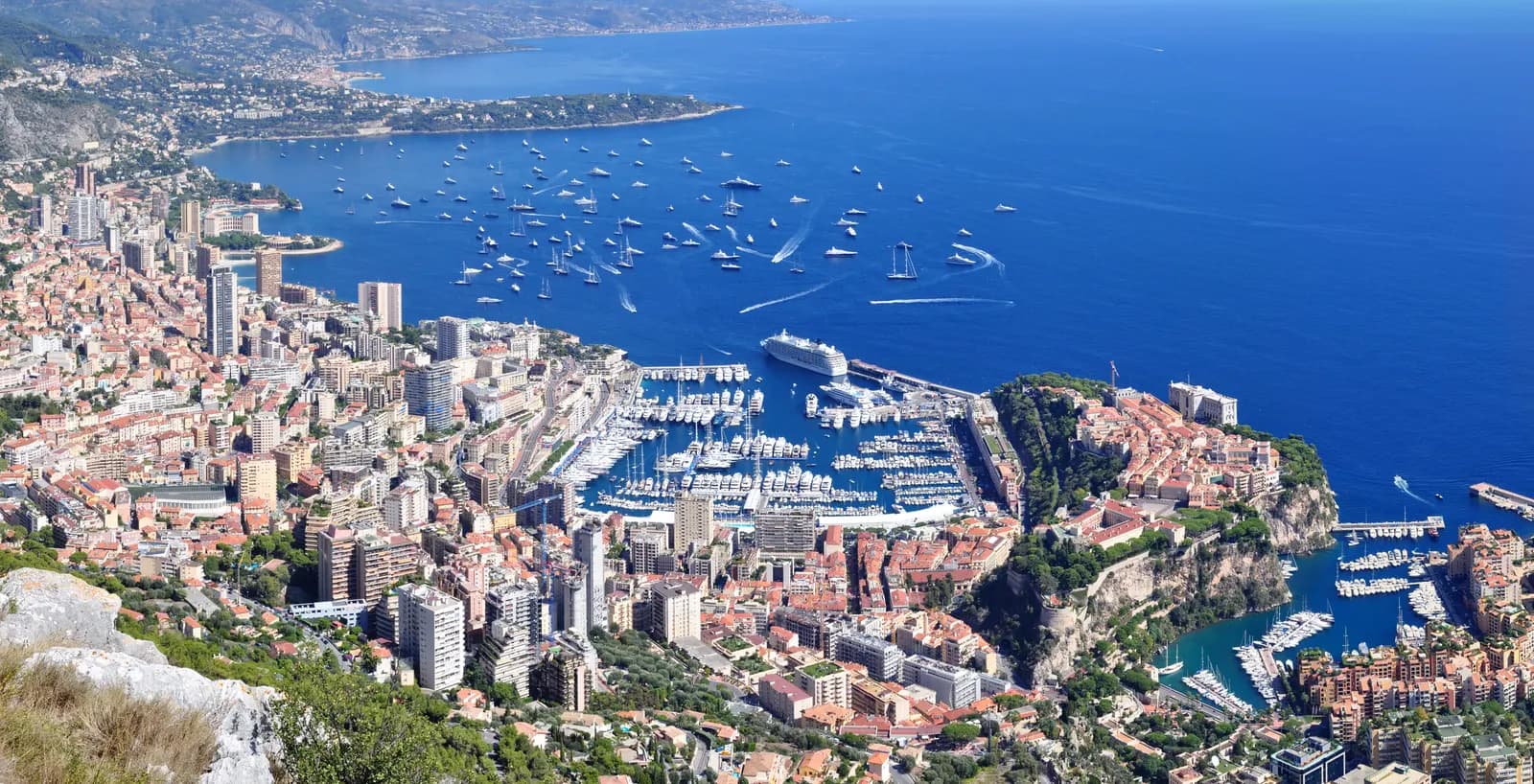
- Capital
- Monaco
- Currency
- EUR
- Region
- Europe
Key figures
- Flight from Parisabout1 hourVerified on Nov 2, 2026
Personal taxation
The Prince's Government states the rule plainly: Monegasque nationals and residents of the Principality are not liable to income tax, at a rate of 0%2. The absence of income tax dates back to an ordinance issued by Prince Charles III in 1869.
The same page immediately sets out the exception that matters to this site: it covers “Monegasque nationals and residents of the Principality, with the exception of French nationals, who are governed by the 1963 bilateral convention between France and Monaco”.
This exception is the central point of any French reflection on Monaco, and it is very widely glossed over in commercial presentations. A French national settled in Monaco remains, in principle, taxable in France on all of their income as if they were domiciled there.
The 1963 convention provides separate treatment for French nationals who can demonstrate habitual residence in Monaco on a continuous basis since a long-standing date set by that text. The precise conditions depend on the convention itself and on its interpretation by the French tax authorities: they must be examined case by case, not presumed.
We do not publish the reference date or the continuity conditions laid down by the 1963 Franco-Monegasque convention: they do not appear in the official extracts available to us, and their exact wording determines the outcome of a case. They must be established with an adviser before any plan is made.
A second caveat appears on the same official page: the absence of income tax “applies only to activities carried out and to persons genuinely established in the Principality”. A purely formal residence therefore has no effect, including for a non-French national.
Residents' private capital gains are not taxed — 0%3 — since there is no personal income tax. Capital gains realised by companies subject to the profits tax, however, remain taxable.
Companies
The profits tax applies to industrial or commercial businesses that generate more than a quarter of their turnover outside Monaco. Its rate stands at more than 25%4 for financial years beginning on or after 1 January 2022, following a gradual reduction that began in 2019.
Inheritance and gifts
Transfer duties on gifts and inheritances depend solely on the degree of kinship, with no progressive scale. In the direct line between parents and children, and between spouses, the rate is 0%5. It rises to 8%6 between siblings, 10%7 between uncles, aunts, nephews and nieces, 13%8 between more distant relatives and 16%9 between unrelated persons.
The territoriality rule is essential: the tax applies to assets located in the Principality, regardless of the domicile, residence or nationality of the deceased or donor. It is therefore a tax on the asset, not on the person.
Residence routes and visas
Monaco is not a member of the European Union, and living there requires a resident card issued by the Sûreté Publique (public security department), whatever the applicant's nationality.
Three conditions shape the application: having accommodation in Monaco, owned or rented and of a size suited to the household; proving sufficient means, generally certified by a local bank; and producing a criminal record extract from the previous countries of residence.
The first condition is the most demanding. In a territory of two square kilometres, housing is the scarce resource, and its cost is the real price of entry — far more than the administrative formalities themselves.
The second requires opening an account with a Monegasque institution, which issues the certificate of means. Local banks apply their own entry thresholds, distinct from the administrative requirements and generally higher.
The Monegasque tax residence certificate, for its part, is issued to foreign nationals holding a valid residence permit who reside in Monaco for more than 183 days10, have their main activity there or spend most of the year there.
This certificate is the document that evidences residence. It in no way exempts a French national from the rules of the 1963 convention, but it is essential for any other nationality wishing to assert Monegasque residence against another state.
The Monegasque passport gives access to about 18011 without a prior visa. Monegasque naturalisation is, however, extremely rare and a matter of sovereign decision: it is not a goal that can be achieved through an ordinary application.
Real estate
The Monegasque market is one of the most expensive in the world per square metre, and this stems from a physical constraint: the territory is tiny and can only expand through land reclamation from the sea, which is slow and exceptional.
The housing stock is divided into two segments of different legal nature. The free sector, open to all, where the prices that are quoted are set. And the protected sector, reserved for Monegasques and certain categories of residents, to which a newcomer has no access.
This duality explains a phenomenon that puzzles outside observers: the Principality is home both to the most expensive real estate in Europe and to a stock of rent-controlled housing whose prices bear no relation to the former.
For someone planning to settle, renting in the free sector is the most common route, buying representing a commitment an order of magnitude greater. Service charges are also high and must be costed separately from the rent or purchase price.
We do not publish Monegasque registration duties, notarial fees or price levels per square metre: they do not appear in the official sources we have been able to verify.
Cost of living
The cost of living in Monaco is that of a very upmarket city centre, with no outskirts to fall back on. Housing outweighs every other item, to an extent without equivalent.
We do not publish a typical monthly budget: we have not found an official Monegasque series measuring a basket of spending comparable to that of an expatriate.
The currency is the euro, under a monetary agreement with the European Union, and Monaco mints its own coins. There is therefore no currency risk for a French resident.
One particularity changes the equation: the immediate proximity of France and Italy makes it possible to do most everyday shopping outside the Principality. Many residents live in Monaco and shop in Beausoleil, Cap-d'Ail or Ventimiglia, which significantly lowers the day-to-day budget.
Some costs remain unavoidable: private international schooling, parking and personal services. Healthcare, on the other hand, relies on a good-quality Monegasque social protection system, backed by the hospital facilities of the Principality and the surrounding region.
Finally, density and traffic are a real everyday constraint that no financial comparison captures. The Principality is very busy, and access by car is restricted for much of the year.
Procedures and timelines
- For a French national, first have the scope of the 1963 convention examined: it determines whether the plan makes sense from a tax standpoint;
- find accommodation in Monaco, the prerequisite and main obstacle of the application;
- open an account with a local institution and obtain the certificate of means;
- submit the resident card application to the Sûreté Publique, with civil status documents and the criminal record;
- where applicable, apply for the tax residence certificate once the presence conditions are met.
The order matters: committing to housing costs before having the situation analysed in light of the 1963 convention is the most expensive mistake a French national can make in Monaco, and it is a common one.
We do not publish processing times or required levels of means: they do not appear in the official sources we have been able to verify.
Points to watch
- A French national falls under the 1963 convention: the absence of Monegasque tax cannot be taken for granted.
- According to the official source, the exemption applies only to persons genuinely established in the Principality.
- Inheritance duties apply to assets located in Monaco whatever the nationality of the deceased, from 0%5 in the direct line to 16%9 between unrelated persons.
- The protected housing sector is not open to newcomers: the free market is the only option.
- Monegasque naturalisation is a matter of sovereign decision and is not a goal that can be planned.
Finally, Monaco is the destination where the gap between reputation and legal reality is widest for a French national. The regime is genuinely favourable, but it was explicitly closed to French nationals by a treaty more than sixty years old, whose very existence is often unknown to prospective movers. For nationals of other countries, on the other hand, the Principality offers a stable framework, remarkable safety and zero personal taxation — provided they genuinely live there, which the authorities check.
Pros and cons
Frequently asked questions
Does a French national pay tax in Monaco?
Yes: under the 1963 Franco-Monegasque convention, French nationals domiciled in Monaco remain subject to French income tax. The tax advantage for a French national is therefore almost nil, apart from inheritance and the ISF under certain conditions.
How do you obtain residency in Monaco?
You need a substantial bank deposit (often ≥ about €500,00014), accommodation (purchased or rented) and a clean criminal record.
Is there inheritance tax in Monaco?
There is no inheritance tax in the direct line.
Banks and accounts
Accept residents of this country
See this country on the tax map
Please note
Sources and verification dates
- 1.
Flight from Paris : 1 hour
Verified on Nov 2, 2026
- 2.
Monaco: personal income tax, except for French nationals : 0%
« Individual Taxation — Monegasque nationals and residents in the Principality, with the exception of French nationals, who are regulated by the 1963 Bilateral Convention between France and Monaco, are not liable for income tax. The lack of income tax dates back to an Ordinance by Prince Charles III in 1869. However, the lack of income tax for individuals only relates to activities that are carried out and persons who are genuinely established in the Principality of Monaco. — Gouvernement Princier, MonServicePublic, « Tax in Monaco ». »
monservicepublic.gouv.mcVerified on Nov 2, 2026Verified source
- 3.
Monaco: taxation of residents' private capital gains : 0%
« Individual Taxation — Monegasque nationals and residents in the Principality, with the exception of French nationals […] are not liable for income tax. — Gouvernement Princier, MonServicePublic, « Tax in Monaco ». Aucun impôt sur le revenu des personnes physiques, donc aucune imposition des plus-values privées ; les plus-values des entreprises soumises à l'ISB restent imposables (page « Impôt sur les bénéfices »). »
monservicepublic.gouv.mcVerified on Nov 2, 2026Verified source
- 4.
Monaco: profits tax rate, financial years beginning on or after 1 January 2022 : 25%
« 25% pour les exercices ouverts à compter du 1er janvier 2022 »
service-public-entreprises.gouv.mcVerified on Nov 2, 2026Verified source
- 5.
Monaco: inheritance and gift tax in the direct line and between spouses : 0%
« Direct filiation between parents and children or spouses0% »
monservicepublic.gouv.mcVerified on Nov 2, 2026Verified source
- 6.
Monaco: inheritance and gift tax between brothers and sisters : 8%
« Between brothers and sisters 8% »
monservicepublic.gouv.mcVerified on Nov 2, 2026Verified source
- 7.
Monaco: inheritance and gift tax between uncles, aunts, nephews and nieces : 10%
« Between uncles, aunts, nephews and nieces: 10% — Gouvernement Princier, MonServicePublic, « Inheritance tax ». »
monservicepublic.gouv.mcVerified on Nov 2, 2026Verified source
- 8.
Monaco: inheritance and gift tax between more distant relatives : 13%
« Between relatives other than brothers, sisters, uncles, aunts, nephews or nieces: 13% — Gouvernement Princier, MonServicePublic, « Inheritance tax ». »
monservicepublic.gouv.mcVerified on Nov 2, 2026Verified source
- 9.
Monaco: inheritance and gift tax between unrelated persons : 16%
« Between persons who are not related: 16% — Inheritance or transfer tax applies to property situated in the territory of the Principality or with situs in Monaco, whatever the domicile, residence or nationality of the deceased person or the donor. — Gouvernement Princier, MonServicePublic, « Inheritance tax ». »
monservicepublic.gouv.mcVerified on Nov 2, 2026Verified source
- 10.
Monaco: length of stay giving entitlement to the tax residence certificate : 183 days
« Reside in Monaco for more than 183 days »
monservicepublic.gouv.mcVerified on Nov 2, 2026Verified source
- 11.
Monegasque passport: visa-free destinations : 180
« Henley Passport Index — classement des passeports par nombre de destinations accessibles sans visa préalable (données IATA), consulté à la date indiquée. Valeur reprise de l’index de l’ancien site (barème à 227 destinations). »
henleyglobal.comVerified on Nov 2, 2026Verified source
- 12.
monaco.divers.minutes.30 : 30 minutes
Verified on Nov 2, 2026
- 13.
monaco.immobilier.eur.50000 : €50,000
Verified on Nov 2, 2026
- 14.
monaco.golden-visa.eur.500000 : €500,000
Verified on Nov 2, 2026