In depth · Taxation
Moving to Dubai in 2026: 0% tax, the Golden Visa and pitfalls to avoid
Dubai does not tax the income of individuals, but it now taxes company profits, and a residence permit there does not amount to tax residency. This report sets out what is accurate, what no longer is, and the three pitfalls that cost French nationals the most.
By Editorial team · on August 20, 2026
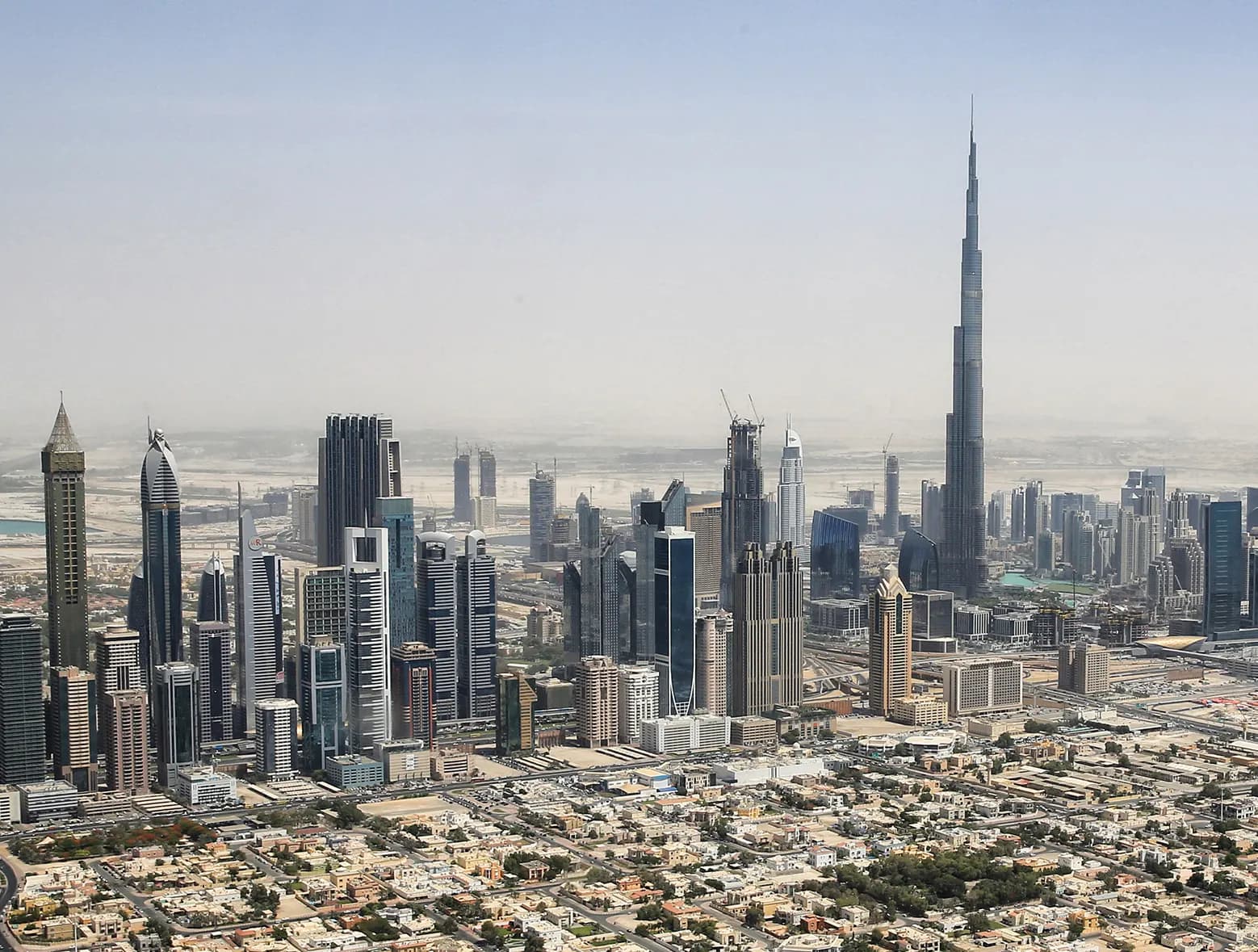
The real taxation of the Emirates
Individuals are not taxed on their income in the United Arab Emirates: the applicable rate is 0%1. Salaries, dividends, capital gains and rents are received free of local tax.
This rule is long-standing and has not been called into question. It is the central argument of Emirati expatriation contracts, and it remains accurate.
What has changed concerns companies. A corporate tax on profits has applied to financial years starting from June 2023, at a rate of 9%2 above taxable profit of AED 375,0003, or roughly about €95,0004.
Free zone companies can keep a zero rate on their qualifying income only, subject to substance conditions and provided they do not exceed a de minimis threshold for non-qualifying income. The exemption is therefore no longer automatic.
An entrepreneur who receives income through an Emirati company must therefore reason in terms of combined cost: the company's tax, then the untaxed distribution at the individual level. The overall rate is no longer zero.
The residence permit through investment
Acquiring a property worth at least from AED 2,000,0005, or roughly about €520,0006, gives access to a renewable residence permit of 10 years7.
This permit allows the holder to sponsor family members and domestic staff, and does not require continuous presence in the country, unlike ordinary residence visas.
Freehold ownership is, however, open to foreigners only in the emirate's designated areas, and keeping the permit requires keeping the property.
Other routes exist — talent, capital investors, highly qualified professionals — with their own conditions, which we do not detail here for lack of a verified, up-to-date official source.
The three pitfalls
The first is confusing a residence permit with tax residency. The Emirates require presence of from 183 days8 over twelve months to establish an individual's tax residency, and obtaining a certificate is a procedure separate from the permit.
Without this certificate, the tax treaty concluded with France cannot be invoked. A ten-year resident who has never applied for it is, from the treaty's point of view, in the same position as a tourist.
The second is the persistence of French domicile. Article 4 B of the Code général des impôts looks at the household, the main place of stay, professional activity and the centre of economic interests. A business owner whose operating company and family remain in France remains domiciled in France, however much time is spent in Dubai.
The third is the cost of living. Dubai is not cheap: international schooling, housing and compulsory health insurance are major expenses, and there is no public alternative for foreigners.
For a seconded employee whose employer covers housing and schooling, the balance is very favourable. For a freelancer who bears these costs, the net advantage is considerably thinner than the zero rate suggests.
What to do, and what remains uncertain
- Document the severance of ties with France: household, activity, economic interests.
- Obtain the Emirates ID card, a prerequisite for opening a bank account.
- Take out the health insurance required for the residence permit.
- Apply for the tax residency certificate as soon as the conditions are met.
- Have your company's activity assessed under the free zone regime, and register with the Federal Tax Authority even if the tax due is zero.
We do not publish the list of qualifying activities in free zones, the de minimis threshold for non-qualifying income, or the detailed conditions of the permits granted to talent and capital investors: these are set by administrative decisions whose current version we have not been able to verify.
The Emirati passport also opens about 1859 visa-free destinations, but naturalisation remains exceptional and is not a goal an expatriate can plan for.
Finally, the general trajectory deserves to be noted. Within a few years, the Emirates have introduced a value added tax, a corporate tax and a minimum tax for large groups. The absence of taxation on individuals remains, but the country is no longer a jurisdiction without taxation.
Frequently asked questions
Do I need to live in Dubai for 183 days to benefit from the 0%?
The from 183 days8 rule is an indicator, not the sole condition. What matters is no longer meeting any of the French residence criteria and obtaining an Emirati tax residency certificate, which requires real presence and substance.
Does the Golden Visa make me a UAE tax resident?
No. The visa gives the right to reside; tax residency is proven separately (presence, housing, centre of interests).
Are dividends from my French company exempt once I am in Dubai?
They can be if you are genuinely an Emirati tax resident, but withholding taxes and the question of the French company's substance must be examined with a tax adviser.
Please note
Sources and verification dates
- 1.
United Arab Emirates: taxation of personal income : 0%
« Taxation — The UAE does not levy income tax on individuals. However, it levies 5 per cent value added tax on the purchase of goods and services, levied at each stage of the supply chain and ultimately borne by the end consumer. — Portail officiel du Gouvernement des Émirats arabes unis (u.ae), « Taxation ». »
u.aeVerified on Nov 2, 2026Verified source
- 2.
United Arab Emirates: corporate tax rate above the threshold : 9%
« CT Rate — As per Ministry of Finance, CT rates are: 0 per cent for taxable income up to AED 375,000 ; 9 per cent for taxable income above AED 375,000 […] The Federal Decree-Law applies to financial years beginning on or after 1 June 2023. — Portail officiel du Gouvernement des Émirats arabes unis (u.ae), « Corporate tax » (Federal Decree-Law No. 47 of 2022). »
u.aeVerified on Nov 2, 2026Verified source
- 3.
United Arab Emirates: taxable profit below which corporate tax is zero : AED 375,000
« As per Ministry of Finance, CT rates are: 0 per cent for taxable income up to AED 375,000 »
u.aeVerified on Nov 2, 2026Verified source
- 4.
United Arab Emirates: approximate equivalent of the corporate tax threshold : €95,000
« CT Rate — 0 per cent for taxable income up to AED 375,000 ; 9 per cent for taxable income above AED 375,000 — u.ae, « Corporate tax ». Seuil légal en dirhams (AED 375 000 ≈ 102 000 USD à la parité fixe ≈ 87 000–94 000 €). »
u.aeVerified on Nov 2, 2026Verified source
- 5.
Dubai: minimum purchase value of a property qualifying for the investor Golden Visa : AED 2,000,000
« Golden Visa application - Investor — This service allows the real estate investor owning a property the purchase value of which is equal to or more than 2 million AED at the time of purchase, to apply for a 10-years renewable residence permit. The husband or wife, children and parents […] — Dubai Land Department (Government of Dubai). »
dubailand.gov.aeVerified on Nov 2, 2026Verified source
- 6.
Dubai: approximate equivalent of the Golden Visa real estate threshold : €520,000
« […] a property the purchase value of which is equal to or more than 2 million AED at the time of purchase — Dubai Land Department. AED 2 000 000 = 544 600 USD (parité fixe 3,6725) ≈ 465 000–500 000 € au cours 2026. »
dubailand.gov.aeVerified on Nov 2, 2026Verified source
- 7.
Dubai: duration of the residence visa granted to the real estate investor : 10 years
« This service allows the real estate investor owning a property the purchase value of which is equal to or more than 2 million AED at the time of purchase, to apply for a 10-years renewable residence permit. »
dubailand.gov.aeVerified on Nov 2, 2026Verified source
- 8.
United Arab Emirates: presence over twelve months giving rise to an individual’s tax residency : 183 days
« If he has been physically present in the State for a period of (183) one hundred and eighty-three days or more, within the relevant (12) twelve consecutive months. »
tax.gov.aeVerified on Nov 2, 2026Verified source
- 9.
United Arab Emirates passport: visa-free destinations : 185
« Henley Passport Index — classement des passeports par nombre de destinations accessibles sans visa préalable (données IATA), consulté à la date indiquée. Valeur reprise de l’index de l’ancien site (barème à 227 destinations). »
henleyglobal.comVerified on Nov 2, 2026Verified source