International mobility news

Hong Kong

Moving to Hong Kong in 2026: Territorial Taxation and an Asian Hub

Hong Kong applies a low-rate territorial tax system (salaries tax capped, no tax on capital gains or foreign dividends) and remains a major financial hub and a gateway to China.

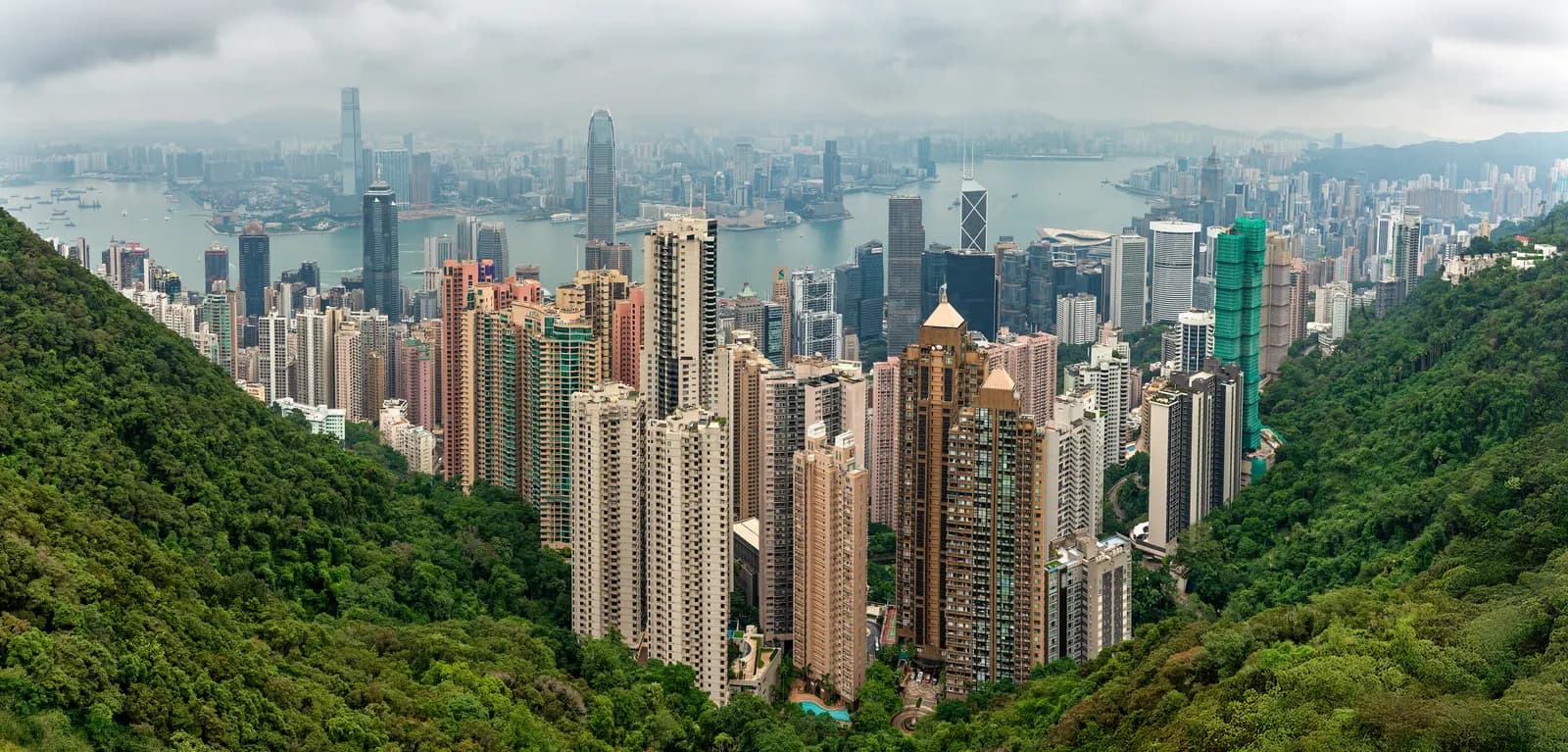
View of Hong Kong
Capital
Hong Kong
Currency
HKD
Region
Asia

Tax regimes at a glance

Each regime answers the same questions. A zero rate applies only to the income, person and period stated.

Your personal taxation

  • Salaries TaxGeneral regime

    Who for?
    Employees and pensioners whose income is sourced in Hong Kong, whether resident or not.
    Which income?
    Employment income and pensions: progressive scale after allowances, capped by the calculation at the two-tier standard rate where that is more favourable.
    Which source?
    Territoriality: only employment income sourced in Hong Kong is taxed; worldwide income is not taxed.
    Conditions
    Annual return; personal allowances for the progressive scale; the source of employment is determined by the place of the employment and where the services are rendered.
    Duration
    Permanent regime.
    Since when?
    Two-tier standard rate from the 2024/25 year of assessment.
    • 2% Hong Kong: rate of the first bracket of the progressive salaries tax scale
    • 17% Hong Kong: top rate of the progressive salaries tax scale
    • 15% Hong Kong: standard rate of salaries tax, first portion of net income
    • HK$5,000,000 Hong Kong: portion of net income taxed at the first standard rate of salaries tax
    • 16% Hong Kong: second tier of the standard rate

    Official source · ird.gov.hk

  • Individuals' investment incomeGeneral regime

    Who for?
    Individuals who hold investments as personal wealth.
    Which income?
    Capital gains, dividends and interest received privately: not taxed. Rental income from property located in Hong Kong falls under Property Tax.
    Which source?
    Not applicable to capital gains and dividends; property located in Hong Kong for rental income.
    Conditions
    Trading activity may lead to gains being reclassified as taxable profits.
    Duration
    Permanent regime.
    Since when?
    In force.
    • 0% Hong Kong: taxation of capital gains

    Official source · fstb.gov.hk

  • New Capital Investment Entrant Scheme (New CIES)Special regime

    Who for?
    Foreign investors with sufficient net assets, and their families.
    Which income?
    No tax benefit of its own: a residence permit, unrelated to taxation.
    Which source?
    Not applicable.
    Conditions
    Minimum net assets and minimum investment in permitted assets, including a placement in the scheme's investment portfolio; the investment must be maintained.
    Duration
    Initial permit renewable; permanent residence possible after a period of continuous residence.
    Since when?
    Scheme open since 1 March 2024.
    • from HK$30,000,000 Hong Kong – New CIES – minimum total investment
    • from HK$30,000,000 Hong Kong – New CIES – minimum net assets
    • up to 24 months Hong Kong – New CIES – duration of the initial permit
    • from 7 years Hong Kong – New CIES – residence before applying for permanent residence

    Official source · newcies.gov.hk

Your company

  • Two-tier Profits TaxGeneral regime

    Who for?
    Companies and sole proprietorships carrying on a business in Hong Kong.
    Which income?
    Business profits: reduced rate on the first band, standard rate beyond; only one entity per group of connected entities benefits from the reduced band.
    Which source?
    Territoriality: only profits sourced in Hong Kong are taxed; a foreign source must be demonstrated transaction by transaction.
    Conditions
    Annual return; accounting records and annual audit for companies.
    Duration
    Permanent regime.
    Since when?
    Two-tier regime since the 2018/19 year of assessment.
    • 8.25% Hong Kong: profits tax rate on the first tier of profits
    • 16.5% Hong Kong: standard profits tax rate for corporations

    Official source · ird.gov.hk

  • Foreign-sourced income regime (FSIE)Conditional

    Who for?
    Entities that are members of a multinational group, regardless of size; it does not apply to individuals or to purely local groups.
    Which income?
    Foreign-sourced dividends, interest, intellectual property income and disposal gains received in Hong Kong: deemed to be Hong Kong-sourced and taxable, subject to exceptions.
    Which source?
    Foreign-sourced income received in Hong Kong.
    Conditions
    Exceptions: economic substance requirement (interest, dividends, gains other than on intellectual property), participation requirement (percentage and minimum holding period) for dividends and gains on securities, nexus requirement for intellectual property; advance ruling possible.
    Duration
    Permanent regime.
    Since when?
    Since 1 January 2023; extended to other disposal gains since 1 January 2024.
    • from 5% Hong Kong, FSIE regime: minimum shareholding required for the participation exemption
    • from 12 months Hong Kong, FSIE regime: minimum holding period for the participation exemption

    Official source · ird.gov.hk

  • Family-owned investment holding vehicles (FIHV)Special regime

    Who for?
    Investment vehicles owned by a family and managed by a single family office in Hong Kong.
    Which income?
    Profits from qualifying transactions: exempt from Profits Tax.
    Which source?
    Qualifying transactions, wherever the assets are located, subject to the conditions of the regime.
    Conditions
    Minimum asset threshold; substantial activities in Hong Kong, including a minimum number of full-time qualified employees. Adjustments announced in the 2025-26 budget; bill planned for 2026, adoption not verified.
    Duration
    As long as the conditions are met.
    Since when?
    Ordinance applicable since May 2023.
    • from HK$240,000,000 Hong Kong: minimum asset threshold for family-owned investment holding vehicles (FIHVs) managed by a single family office
    • from 2 Hong Kong: minimum number of full-time qualified employees required for the FIHV regime

    Official source · legco.gov.hk

  • Global minimum tax and Hong Kong Minimum Top-up Tax (HKMTT)Conditional

    Who for?
    Entities of multinational groups whose consolidated revenue reaches the threshold in at least two of the four preceding fiscal years. Does not apply to businesses below the threshold.
    Which income?
    Top-up tax raising the effective rate of Hong Kong entities to the minimum rate, and additional taxation of lightly taxed foreign subsidiaries.
    Which source?
    Profits of the group's entities in Hong Kong and abroad, under the GloBE rules.
    Conditions
    Separate registration and filings.
    Duration
    Permanent regime.
    Since when?
    Fiscal years beginning on or after 1 January 2025; law passed by the Legislative Council in May 2025.
    • from 15% Hong Kong: minimum rate of the global minimum tax and of the Hong Kong top-up tax (HKMTT)
    • from €750,000,000 Hong Kong: consolidated revenue threshold above which the minimum tax for multinational groups applies

    Official source · ird.gov.hk

Compare with other countries:Foreign incomeCompany taxationRegimes for new residents

Key figures

  • Population7,500,000Verified on Nov 2, 2026
  • Flight from Parisabout12 hoursVerified on Nov 2, 2026

Personal taxation

Hong Kong does not tax worldwide income. The territory levies tax only on business profits, rental income from property located there, and employment income sourced there. This is strict territoriality, and it underpins everything else.

As a result, there is no tax on capital gains — the applicable rate is 0%3 —, no taxation of dividends at shareholder level, and no value added tax.

Salaries tax

The taxpayer is taxed on the more favourable of two calculations. The first is a progressive scale applied to net chargeable income after allowances: it starts at 2%4 and reaches 17%5 on the balance.

The second is a standard rate applied to net income before allowances. It has become a two-tier progressive rate: 15%6 on the first HK$5,000,0007 of net income, then 16%8 beyond that.

This more-favourable-calculation mechanism is a distinctive feature: it ensures that the burden never exceeds the standard rate, which in effect caps the taxation of high-earning employees.

Companies

Profits tax is also two-tier: 8.25%9 on the first band of profit, then 16.5%10 beyond that, for companies.

Here again, only Hong Kong-sourced profit is taxed. Profit made outside the territory may escape tax, but this characterisation is closely examined by the authorities and requires solid evidence. It is the territory's main tax dispute issue.

The foreign-sourced income regime (FSIE), in force since 1 January 2023, regulates this exception for entities that are members of a multinational group: foreign-sourced dividends, interest, intellectual property income and disposal gains received in Hong Kong are deemed taxable, with gains on other assets covered since 1 January 2024. The exemption is maintained if the entity meets an economic substance requirement locally, a participation requirement for dividends and gains on securities — at least from 5%11 of the capital, held for at least from 12 months12 —, or a nexus requirement for intellectual property. The regime applies neither to individuals nor to purely local groups, and an advance ruling may be requested before any structuring.

For a French national, a clarification is needed on pensions. The absence of Hong Kong taxation does not mean that the pension escapes tax: it is the applicable treaty that determines which of the two States may tax, and a pension of French source frequently remains taxable in France. The analysis therefore starts from the treaty, not from local domestic law.
Residence routes and visas

Hong Kong has opened several routes designed to attract skilled profiles without requiring a prior job offer.

The Top Talent Pass

The scheme distinguishes three categories. The first covers people whose annual income reached from HK$2,500,00013 in the year preceding the application. The other two are aimed at graduates of eligible universities, depending on whether or not they can show at least from 3 years14 of experience over the last five years.

The initial length of stay is 36 months15 for the first category and 24 months16 for the other two, with no condition attached other than the time limit — the holder is therefore not tied to any employer.

The investment route

The programme for investors requires a minimum net investment of HK$30,000,00017, or approximately about $3,800,00018, in permitted assets.

The gap with European thresholds is considerable: this programme is not aimed at the same audience as the Mediterranean schemes, and it is calibrated for substantial wealth.

The list of permitted assets and the obligations to maintain the investment do not appear in our sources: they must be verified with the competent authority.

One practical point deserves to be anticipated: permanent residence is acquired after a period of continuous stay, and it changes the holder's status — it is no longer tied to a visa. The conditions for this transition should be checked from the moment of arrival, because it is the continuity of the stay, and not merely its cumulative length, that is assessed.

Real estate

Acquisition by a foreigner is possible without any special authorisation, but the Hong Kong market is one of the most expensive in the world relative to income, and one of the smallest in terms of living space.

Land belongs in principle to the State, with properties held under long-term leases. The remaining term of the lease attached to a property must be checked: it determines both its value and its financing capacity.

Acquisitions by non-residents have been subject to additional duties, as part of market-cooling measures, the level of which has varied over the cycles.

We do not publish the current level of duties applicable to non-resident buyers: these measures have been amended several times and we have no dated official source to cite.

For the vast majority of expatriates, the question therefore remains one of renting. Rents are high, leases are generally short, and the space obtained for a given budget bears no comparison with that of a European capital.

Finally, it should be noted that advertised floor areas are not always measured in the same way: the distinction between gross area and saleable area has long caused confusion in listings. Comparing two properties requires bringing prices back to the same basis of measurement, failing which the apparent difference is meaningless.

Cost of living

Hong Kong combines one of the lightest tax burdens in the world with one of the highest housing costs. The trade-off rests almost entirely on these two factors.

We do not publish a typical monthly budget: we have not found an official Hong Kong series measuring a basket of expenses comparable to that of an expatriate.

Three items shape a budget. Housing, by far the largest. International schooling, with waiting lists and, in some schools, debentures or capital levies payable in addition to annual fees. And healthcare, where the public system is inexpensive but overstretched, which pushes expatriates towards private care and insurance.

Conversely, the absence of value added tax and the moderate cost of transport and everyday dining ease daily life. The territory is expensive for housing and schooling, not for living.

Procedures and timelines

  1. Identify the applicable visa category, since the documents required and the duration granted depend directly on it;
  2. plan schooling ahead, the most constrained item for a family;
  3. open a local bank account, a step that requires a substantial compliance file;
  4. for a business activity, have the source of profits characterised from the moment the structure is set up, rather than trying to justify it after the fact;
  5. deal with the departure from France on its own criteria, as Hong Kong's territoriality settles nothing on that side.

The fourth point is the one that distinguishes solid files from the rest. Territoriality is not a status that one obtains; it is a characterisation that one demonstrates, transaction by transaction.

We do not publish processing times: we have no official, dated, quantified source for Hong Kong visas.

Points to watch

  • Territoriality protects foreign-source income, but it has to be demonstrated. Substance requirements have become stricter.
  • A visa does not confer tax residence, and Hong Kong tax residence does not mean you have left French tax domicile.
  • Housing absorbs a share of income unmatched in European capitals: the tax advantage has to be assessed net of this item.
  • The remaining term of land leases determines the value of a property.
  • The political and legal context has changed since 2020: it is a project parameter, separate from taxation, and must be assessed on its own merits.

Finally, Hong Kong remains one of the few territories where an employee's tax is capped by design, thanks to the mechanism of the most favourable calculation. For a very high-income executive with no children to put through school, the gap with Europe is considerable; for a family, housing and schooling absorb most of it.

Advantages & disadvantages

Pros

  • Income tax capped at 16%8, strict territoriality, no capital gains tax or inheritance tax

  • English-speaking financial and air hub of Asia

  • Healthcare and international schools of a very high standard (including a French lycée)

Cons

  • The most expensive property in the world, extreme density

  • Political uncertainty since 2020 (reduced autonomy with respect to Beijing)

  • Pollution, humid summers

  • Residence is conditional on a job, recognised talent or substantial capital

Frequently asked questions

How is Hong Kong taxed?

On a territorial basis: salaries tax is capped at a low rate, with no tax on capital gains or on foreign-source dividends.

How do you settle in Hong Kong?

Mainly through a skilled job or through programmes aimed at talent and investors.

Is property expensive?

Yes, among the most expensive in the world.

Residence and citizenship by investment programmes

Data shared with the comparison tool: same amounts, same sources. Compare with other programmes

New Capital Investment Entrant Scheme

Residence · Open · Official page

Minimum entry
  • from HK$30,000,000 — investment, main applicantPermissible assets (shares, bonds, funds, real estate subject to a cap…); includes the amount placed in the CIES portfolioinfo.gov.hk · Verified on Nov 2, 2026
Government fees (main applicant)
Not provided
Family
Not provided
Processing time
  • about 21 days — processing time, main applicantAbout three weeks; official estimate, not guaranteedinfo.gov.hk · Verified on Oct 13, 2026
Required stay
Not provided
Permit duration
  • up to 24 months — permit duration, main applicantInitial permission to stay, followed by extensions of up to 3 yearsnewcies.gov.hk · Verified on Nov 2, 2026

Banks and accounts

Accounts held in this country

Banks and accounts for this country

See this country on the tax map

Please note

General information, as of the date shown. A draft reform is not a rule in force: check the conditions with the authorities or a professional before deciding. Terms of use and disclaimers

Sources and verification dates

  1. 1.

    Population : 7,500,000

    Verified on Nov 2, 2026

  2. 2.

    Flight from Paris : 12 hours

    Verified on Nov 2, 2026

  3. 3.

    Hong Kong: taxation of capital gains : 0%

    « We only levy taxes on business profits under profits tax, property rental income under property tax and employment income under salaries tax. Salaries tax rate is capped at 15% whereas profits tax rate for corporations is 16.5%. There is no value-added or sales tax; no capital gains tax; no withholding tax on dividends and interest; and no estate duty in Hong Kong. — Financial Services and the Treasury Bureau, « Prevailing Tax Policy ». »

    fstb.gov.hkVerified on Nov 2, 2026Verified source

  4. 4.

    Hong Kong: rate of the first bracket of the progressive salaries tax scale : 2%

    « Year of Assessment 2020/21 onwards — Net chargeable Income / Rate : On the First $50,000 — 2% ; On the Next $50,000 — 6% ; On the Next $50,000 — 10% ; On the Next $50,000 — 14% ; Remainder — 17%. Standard Rate — 2024/25 onwards : Two-tiered Standard Rates — On the first $5,000,000 of net income 15% ; Remainder 16%. — GovHK / Inland Revenue Department, « Tax Rates of Salaries Tax & Personal Assessment ». »

    gov.hkVerified on Nov 2, 2026Verified source

  5. 5.

    Hong Kong: top rate of the progressive salaries tax scale : 17%

    « On the Next 50,000 14% 7,000 200,000 16,000 Remainder 17% »

    gov.hkVerified on Nov 2, 2026Verified source

  6. 6.

    Hong Kong: standard rate of salaries tax, first portion of net income : 15%

    « On the first $5,000,000 of net income - 15% »

    Inland Revenue Department (Hong Kong), « Allowances, Deductions and Tax Rate Table (PAM 61) »Verified on Nov 2, 2026Verified source

  7. 7.

    Hong Kong: portion of net income taxed at the first standard rate of salaries tax : HK$5,000,000

    « On the first $5,000,000 of net income - 15% »

    Inland Revenue Department (Hong Kong), « Allowances, Deductions and Tax Rate Table (PAM 61) »Verified on Nov 2, 2026Verified source

  8. 8.

    Hong Kong: second tier of the standard rate : 16%

    « Standard Rate — Year of Assessment 2020/21 to 2023/24 : 15% ; 2024/25 onwards : Two-tiered Standard Rates — On the first $5,000,000 of net income 15% ; Remainder 16%. — GovHK / Inland Revenue Department, « Tax Rates of Salaries Tax & Personal Assessment ». »

    gov.hkVerified on Nov 2, 2026Verified source

  9. 9.

    Hong Kong: profits tax rate on the first tier of profits : 8.25%

    « Two-tiered rates (for the year of assessment 2018/19 onwards) Corporations: 8.25% on assessable profits up to $2,000,000; and 16.5% on any part of assessable profits over $2,000,000 »

    ird.gov.hkVerified on Nov 2, 2026Verified source

  10. 10.

    Hong Kong: standard profits tax rate for corporations : 16.5%

    « Normal rate (for the year of assessment 2008/09 onwards) Corporations: 16.5% »

    ird.gov.hkVerified on Nov 2, 2026Verified source

  11. 11.

    Hong Kong, FSIE regime: minimum shareholding required for the participation exemption : 5%

    « not less than 5% of equity interests in the investee entity concerned »

    Inland Revenue Department (Hong Kong), « Foreign-sourced Income Exemption »Verified on Nov 2, 2026Verified source

  12. 12.

    Hong Kong, FSIE regime: minimum holding period for the participation exemption : 12 months

    « for a period of not less than 12 months immediately before »

    Inland Revenue Department (Hong Kong), « Foreign-sourced Income Exemption »Verified on Nov 2, 2026Verified source

  13. 13.

    Hong Kong, Top Talent Pass: annual income required under category A : HK$2,500,000

    « persons with annual income reaching HK$2.5 million or above, or its equivalent in foreign currency, in the year immediately preceding the date of application »

    immd.gov.hkVerified on Nov 2, 2026Verified source

  14. 14.

    Hong Kong, Top Talent Pass: work experience required in category B, over the previous five years : 3 years

    « degree graduatesNote 2 & 3 of the eligible universitiesNote 4 with at least three years of work experienceNote 5 over the past five years immediately preceding the date of applicationNote 6 (Category B) »

    immd.gov.hkVerified on Nov 2, 2026Verified source

  15. 15.

    Hong Kong, Top Talent Pass: initial period of stay granted in category A : 36 months

    « Successful TTPS applicant will normally be granted an initial stay of 36 months (Category A) / 24 months (Categories B and C) on time limitation only »

    immd.gov.hkVerified on Nov 2, 2026Verified source

  16. 16.

    Hong Kong, Top Talent Pass: initial period of stay granted in categories B and C : 24 months

    « Successful TTPS applicant will normally be granted an initial stay of 36 months (Category A) / 24 months (Categories B and C) on time limitation only »

    immd.gov.hkVerified on Nov 2, 2026Verified source

  17. 17.

    Hong Kong: minimum net investment under the investor programme : HK$30,000,000

    « An Applicant must make investment of a minimum of HK$30 million Net (or equivalent in foreign currencies) in the Permissible investment assets. Assets acquired before the launch date of the Scheme shall not be counted towards the fulfillment of minimum investment threshold. […] net assets […] with a Market value of not less than HK$30 million Net (or equivalent in foreign currencies) throughout the six months preceding the date he lodged his application for Net Asset Assessment — New Capital Investment Entrant Scheme (InvestHK / Immigration Department), « Eligibility Criteria ». »

    newcies.gov.hkVerified on Nov 2, 2026Verified source

  18. 18.

    Hong Kong: approximate equivalent of the investor programme threshold : $3,800,000

    « An Applicant must make investment of a minimum of HK$30 million Net (or equivalent in foreign currencies) in the Permissible investment assets. — New Capital Investment Entrant Scheme, « Eligibility Criteria ». 30 M HK$ ≈ 3,85 M US$ (parité quasi fixe 7,8 HKD/USD). »

    newcies.gov.hkVerified on Nov 2, 2026Verified source