International mobility news

Singapore

Moving to Singapore in 2026: Territorial Taxation, Business Hub and Quality of Life

Singapore combines mild territorial taxation (foreign income largely untaxed, no capital gains tax), a global business hub and an exceptional quality of life. Permanent residence, however, is selective.

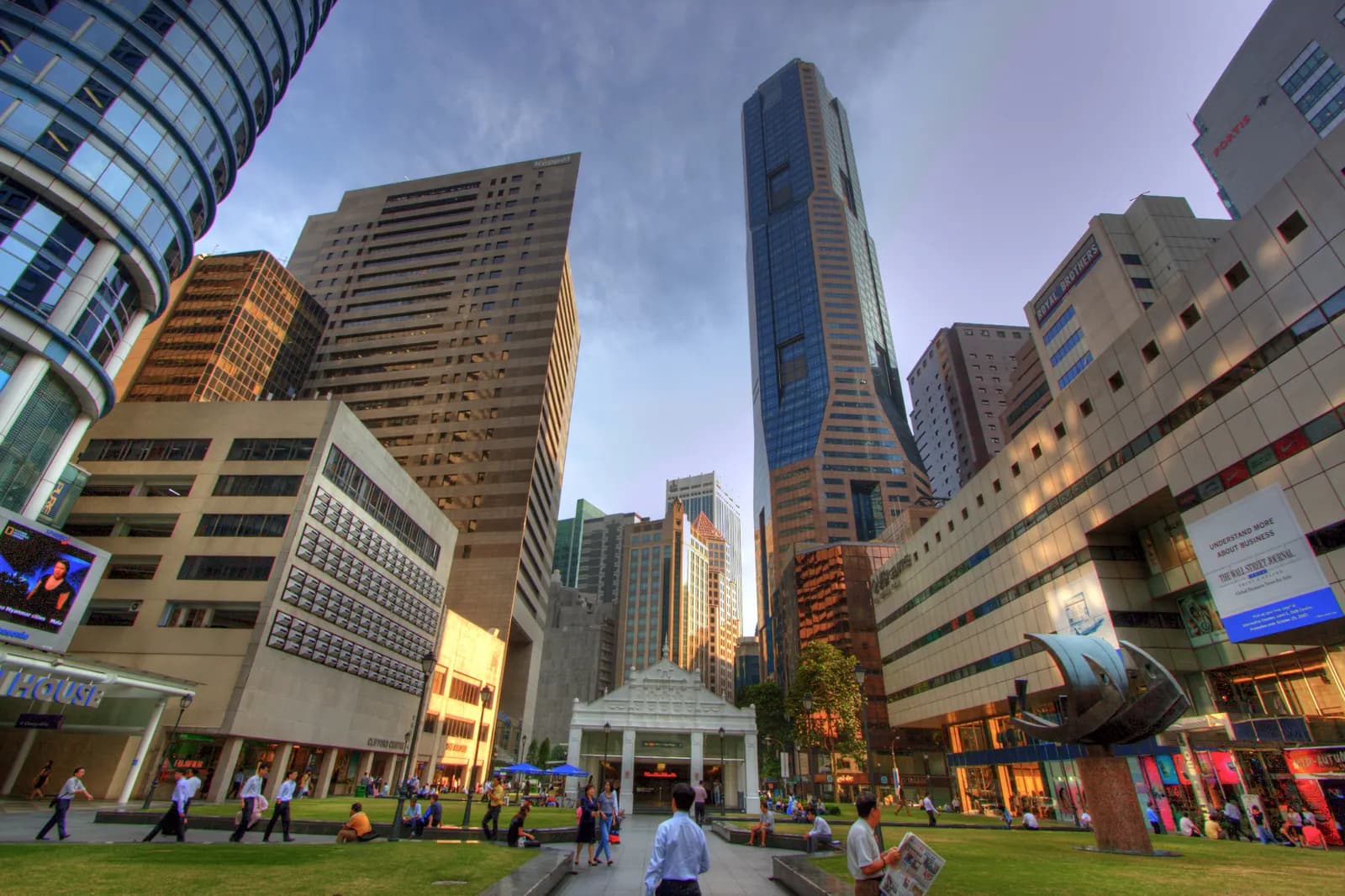
View of Singapore
Photo: Ramir Borja. — Wikimedia Commons (CC BY-SA)
Capital
Singapore
Currency
SGD
Region
Asia
Memberships
Commonwealth

Tax regimes at a glance

Each regime answers the same questions. A zero rate applies only to the income, person and period stated.

Your personal taxation

  • Resident individual income taxGeneral regime

    Who for?
    Individuals who are tax resident, in particular through presence or work in Singapore above the threshold during the previous calendar year.
    Which income?
    Salaries, employment income, rents and other taxable income: a short progressive scale. Non-residents are subject to separate rates, not covered here.
    Which source?
    Income from Singapore sources. Foreign-source income received in Singapore by a resident is in principle exempt, except for income received through a Singapore partnership.
    Conditions
    Annual return; personal reliefs; income-by-income analysis of the source and the nature of the flow.
    Duration
    Permanent regime.
    Since when?
    In force; resident rate scale applicable in 2026.
    • 183 days Singapore: annual presence conferring tax resident status
    • 0% Singapore: rate of the first band of the resident schedule
    • 24% Singapore: top marginal rate of the resident schedule

    Official source · iras.gov.sg

  • Capital gains of individualsGeneral regime

    Who for?
    Individuals holding property, shares or financial instruments as an investment.
    Which income?
    Capital gains on disposal: in principle not taxed.
    Which source?
    Not applicable.
    Conditions
    Gains from an activity amounting to trading (frequency of transactions, financing, intention) are taxed as business income.
    Duration
    Permanent regime.
    Since when?
    In force.
    • 0% Singapore: taxation of gains on the disposal of property, shares and financial instruments

    Official source · iras.gov.sg

  • Not Ordinarily Resident (NOR) SchemeTemporaryExpired

    Who for?
    Formerly: new residents who were non-resident in the years before their arrival.
    Which income?
    Formerly: taxation of employment income in proportion to the time spent in Singapore and exemption of certain employer contributions.
    Which source?
    Employment income.
    Conditions
    Closed scheme: no further status is granted.
    Duration
    The last status was granted for the 2020 year of assessment and expired with the 2024 year of assessment.
    Since when?
    Abolished by the Income Tax (Amendment) Bill 2019; no effect for an arrival in 2026.

    Official source · mof.gov.sg

  • Global Investor Programme (GIP)Special regime

    Who for?
    Entrepreneurs, investors and family office executives with substantial wealth and a substantial business track record.
    Which income?
    No tax advantage of its own: permanent resident status.
    Which source?
    Not applicable.
    Conditions
    One of the investment options: a new or expanding business, an approved fund, or a family office with a minimum amount of assets under management; in-depth review and substance requirements.
    Duration
    Re-entry permit renewable subject to conditions.
    Since when?
    In force, options revised in 2023.
    • from SGD 10,000,000 Singapore – GIP – option A: investment in a business
    • from SGD 25,000,000 Singapore – GIP – option B: GIP-approved fund
    • from SGD 200,000,000 Singapore – GIP – option C: family office (assets under management)
    • 5 years Singapore – GIP – duration of the Re-Entry Permit (REP)

    Official source · edb.gov.sg

Your company

  • Corporate income tax: standard regimeGeneral regime

    Who for?
    Resident companies and Singapore establishments of foreign companies.
    Which income?
    Taxable profit at a single rate, with partial exemptions and an exemption for start-up companies subject to conditions (details not verified).
    Which source?
    Profits from Singapore sources and foreign income received in Singapore; exemption, subject to conditions, for dividends, branch profits and foreign service income received.
    Conditions
    No withholding tax on dividends, one-tier system with tax levied at company level; annual return.
    Duration
    Permanent regime.
    Since when?
    In force.
    • 17% Singapore: corporate income tax rate

    Official source · iras.gov.sg

  • Family office funds (schemes 13O, 13OA and 13U)Special regime

    Who for?
    Fund vehicles managed by a single family office or a manager based in Singapore, approved by the Monetary Authority of Singapore.
    Which income?
    Specified income from designated investments: exempt from tax.
    Which source?
    Designated investments, in Singapore or abroad.
    Conditions
    Minimum amount of designated investments depending on the scheme, minimum number of qualified investment professionals (at least one of whom is outside the family), minimum local spending, conditions to be met throughout the incentive period.
    Duration
    Incentive period set at approval; application deadline not verified.
    Since when?
    In force; conditions updated by circular FDD Cir 05/2026 of the Monetary Authority of Singapore.
    • from SGD 20,000,000 Singapore: minimum amount of designated investments for a single family office fund under the 13O/13OA scheme
    • from SGD 50,000,000 Singapore: minimum assets under management in designated investments for a single family office fund under the 13U scheme

    Official source · mas.gov.sg

  • Top-up taxes for large groups (DTT and MTT)Conditional

    Who for?
    Multinational groups whose annual revenue reaches the threshold in at least two of the four preceding financial years. Does not apply to companies below the threshold.
    Which income?
    Domestic Top-up Tax on Singapore entities and Multinational Enterprise Top-up Tax on low-taxed foreign subsidiaries.
    Which source?
    Profits of the group's entities in Singapore and abroad, under the GloBE rules.
    Conditions
    Separate registration and filings with the IRAS.
    Duration
    Permanent regime.
    Since when?
    Financial years beginning on or after 1 January 2025 (Multinational Enterprise (Minimum Tax) Act 2024).
    • from 15% Singapore: minimum effective tax rate imposed on large multinational groups (DTT and MTT)
    • from €750,000,000 Singapore: annual group revenue above which the top-up taxes (DTT and MTT) apply

    Official source · mof.gov.sg

Compare with other countries:Foreign incomeCompany taxationRegimes for new residents

Key figures

  • Population5,900,000Verified on Nov 2, 2026
  • Flight from Parisabout13 hoursVerified on Nov 2, 2026

Taxation of individuals

Singapore taxes on a territorial basis with a short progressive scale. A person is treated as tax resident for a year of assessment in particular if they stayed or worked in the city-state 183 days3 during the previous calendar year.

The resident scale starts at 0%4 on the first bracket and peaks at 24%5. This top marginal rate is half that of the major European countries, on a high income.

The most significant point, however, lies elsewhere: gains from the disposal of property, shares or financial instruments are, as a general rule, not taxable. The rate applicable to capital gains is 0%6.

This absence of tax on capital gains is not unconditional: gains made in the course of a trading activity may be reclassified as business income and taxed accordingly. The boundary is assessed on indicators — frequency of transactions, financing, intention — and it is the main point of vigilance for an active investor.

Companies

Corporate income tax is a single rate of 17%7 on taxable profit, with partial exemptions for start-up companies and sector-specific tax credits.

There is no withholding tax on dividends paid by a Singapore company, as the system is one-tier: profit is taxed at company level, and the distribution bears no second layer of tax.

The preferential regimes for family office funds, by contrast, are documented by the Monetary Authority of Singapore, which approves them. Income from designated investments is exempt there, provided that the fund maintains throughout the incentive period an amount of designated investments of from SGD 20,000,0008 under schemes 13O and 13OA, or from SGD 50,000,0009 under scheme 13U, employs a minimum number of qualified investment professionals, at least one of whom is outside the family, and incurs minimum spending in Singapore.

We do not publish the details of the exemptions applicable to start-up companies: they rely on criteria that we have not been able to verify against a dated official source.

Lastly, it is worth measuring what Singapore's territoriality covers. Foreign-source income received by a resident individual is, in principle, not taxed when it is received in Singapore, subject to exceptions and conditions specific to certain categories. As elsewhere, the principle is checked income by income and not applied as a general rule: it is the analysis of the source and the nature of the flow that decides.

Residence routes and visas

Singapore pursues a selective and explicit immigration policy. Long-term residence almost always goes through a work pass, whose categories are ranked by level of pay and qualification.

For the investor, the dedicated programme — the Global Investor Programme — rests on three quantified options since its revision in March 2023. The first requires an investment of at least SGD 10,000,00010 in a new business entity or in the expansion of an existing business; the second, an investment of at least from SGD 25,000,00011 in a fund approved under the programme; the third, the setting up of a family office whose assets under management reach at least from SGD 200,000,00012. The options that predated this revision, with lower thresholds, have been abolished.

The order of magnitude places the programme: it is not aimed at an ordinary expatriate but at entrepreneurs and families with substantial wealth, and it comes with substance requirements and an in-depth review.

Three statuses that are often confused must be distinguished: the work pass, which is tied to an employer; permanent residence, which is independent of it; and citizenship, which requires renouncing any other nationality, as Singapore does not allow dual nationality for adults.

The pay thresholds of the various categories of work pass, as well as the criteria for granting permanent residence, do not appear in the official sources we were able to consult: we do not put figures on them.

One last point sets Singapore apart from most destinations: the stability of its rules. Thresholds change, but the institutional framework and administrative predictability are among the highest in the world. For a long-term wealth project, this predictability is worth as much as a percentage point of tax rate, and it explains part of the premium the country charges on housing.

Property

This is the area where Singapore is most restrictive, and it must be understood before any project. The acquisition of housing by foreigners is tightly regulated, and landed properties such as detached houses are in principle closed to them without specific authorisation.

Above all, acquisitions by non-residents and by residents owning several properties bear additional duties whose level is, to our knowledge, among the highest in the world. They have been raised several times as part of the policy of controlling prices.

We do not publish the rate of the additional duties applicable to foreign buyers: it has changed several times and we have no dated official source to cite. As this figure is decisive — it can represent a major fraction of the price — it must be verified with the authorities before any commitment.

The practical consequence is simple: for the vast majority of expatriates, the property question in Singapore is a question of renting, not buying. The rental market is tight and leases are short, which exposes tenants to frequent rent revisions.

Public housing, which houses the majority of the population, is not accessible to foreigners on the same terms, which concentrates expatriate demand on a narrow private segment.

Cost of living

Singapore regularly ranks among the most expensive cities in the world for an expatriate. The absence of tax on capital gains and a moderate rate scale do not automatically offset this level of spending.

We do not publish a typical monthly budget: we have not found an official Singaporean series measuring a basket of expenses comparable to that of an expatriate.

Three items dominate and add up. Housing, the first of them, in a narrow private rental market. International schooling, whose fees are among the highest in the world and which concerns all expatriate children, as public schools are hard for them to access. And the car, whose cost is deliberately dissuasive through the certificate of entitlement system.

This last point is not a drawback for everyone: public transport is excellent and the city is compact. But it must be anticipated by anyone who planned to keep a car-based lifestyle.

Procedures and timelines

  1. First obtain the pass corresponding to your situation: it determines your settling in, your bank account and your children's schooling;
  2. plan schooling well in advance, as places in international schools are limited;
  3. treat the property question as a rental question, unless there is a specific project that has been costed against the additional duties;
  4. for an active investor, document the investment nature of one's transactions, since the boundary with trading determines the taxation of gains;
  5. deal with the departure from France according to its own criteria and under the applicable convention.

We do not publish processing times for Singaporean permits: we have no official source that is both dated and quantified.

Points to watch

  • The capital gains exemption is not absolute: an activity amounting to trading is taxable as business income.
  • The additional stamp duties on property purchases by foreigners are the country's main financial obstacle: they must be quantified before any project is undertaken.
  • Citizenship requires renouncing one's original nationality: this is a choice of a different nature from that in countries that allow dual nationality.
  • The cost of schooling and housing can absorb the tax advantage for a middle-income family.
  • The Singaporean passport gives visa-free access to about 19513, one of the best levels in the world — but at the price of the renunciation mentioned above.

Finally, Singapore is a destination where the trade-off depends less on the tax rate than on the structure of unavoidable expenses. A single person on a high income clearly comes out ahead; a family of four with two children in school must redo the calculation item by item, and the result is not always what a comparison of tax scales suggests.

Advantages & disadvantages

Pros

  • No tax on capital gains or inheritances; foreign income not remitted to Singapore is exempt

  • Maximum stability, safety and administrative efficiency; an Asian hub

  • Healthcare and schools (including a French lycée) among the best in the world

Cons

  • Cost of living and property prices among the highest in the world

  • Residence is difficult to obtain (no simple passive-income visa)

  • Property purchases heavily taxed for foreigners (high ABSD rates)

  • Obtaining residence requires a genuine project (employment/business) or a very substantial amount of capital

Frequently asked questions

Does Singapore tax foreign income?

Foreign-source income that is not remitted is largely untaxed, and there is no capital gains tax.

Is permanent residence easy to obtain?

No: it is selective. Most often, one starts with an Employment Pass tied to a skilled job.

Is the cost of living high?

Yes, among the highest in Asia.

Residence and citizenship by investment programmes

Data shared with the comparison tool: same amounts, same sources. Compare with other programmes

Global Investor Programme (permanent residency)

Residence · Open · Official page

Minimum entry
  • from SGD 10,000,000 — investment, main applicantNew or expanding business in Singapore, stake of at least 30%, invested within 6 months of approval in principleedb.gov.sg · Verified on Nov 2, 2026
  • from SGD 25,000,000 — investment, main applicant“GIP-select” fund investing in Singapore companies; from a personal account with a bank in Singaporeedb.gov.sg · Verified on Nov 2, 2026
  • from SGD 200,000,000 — investment, main applicantSingle Family Office in Singapore; at least SGD 50 M deployed in investments designated by the EDB, within 12 monthsedb.gov.sg · Verified on Nov 2, 2026
Government fees (main applicant)
  • SGD 10,000 — government fees, main applicantPayable before submission, non-refundable whatever the outcomeedb.gov.sg · Verified on Oct 13, 2026
Family
Not provided
Processing time
  • about 12 months — processing time, main applicantOfficial estimate, not guaranteededb.gov.sg · Verified on Oct 13, 2026
Required stay
Not provided
Permit duration
  • 5 years — permit duration, main applicantRe-Entry Permit accompanying permanent residence; renewal if resident for more than half of the timeedb.gov.sg · Verified on Nov 2, 2026

Banks and accounts

Accounts held in this country

Banks and accounts for this country

See this country on the tax map

Please note

General information, as of the date shown. A draft reform is not a rule in force: check the conditions with the authorities or a professional before deciding. Terms of use and disclaimers

Sources and verification dates

  1. 1.

    Population : 5,900,000

    Verified on Nov 2, 2026

  2. 2.

    Flight from Paris : 13 hours

    Verified on Nov 2, 2026

  3. 3.

    Singapore: annual presence conferring tax resident status : 183 days

    « Foreigner who has stayed/worked in Singapore: a. For at least 183 days in the previous calendar year; or »

    iras.gov.sgVerified on Nov 2, 2026Verified source

  4. 4.

    Singapore: rate of the first band of the resident schedule : 0%

    « Resident tax rates — From YA 2024 onwards — Chargeable Income / Income Tax Rate (%) / Gross Tax Payable ($) : First $20,000 — 0 — 0 ; Next $10,000 — 2 — 200 — IRAS, « Individual Income Tax rates » (dernière mise à jour 27 avril 2026). »

    iras.gov.sgVerified on Nov 2, 2026Verified source

  5. 5.

    Singapore: top marginal rate of the resident schedule : 24%

    « Singapore's personal income tax rates for tax resident individuals are progressive, meaning individuals with higher income are taxed at a higher rate. The current highest personal income tax rate is at 24%. — Resident tax rates from YA 2024 onwards : […] In excess of $1,000,000 — 24 — IRAS, « Individual Income Tax rates » (dernière mise à jour 27 avril 2026). »

    iras.gov.sgVerified on Nov 2, 2026Verified source

  6. 6.

    Singapore: taxation of gains on the disposal of property, shares and financial instruments : 0%

    « Gains from the sale of a property, shares and financial instruments in Singapore are generally not taxable. However, gains from "trading in properties" may be taxable. […] The following gains are generally not taxable: Gains derived from the sale of a property in Singapore as it is a capital gain. Profits or losses derived from the buying and selling of shares or other financial instruments (including digital tokens) are generally viewed as personal investments. — IRAS, « Gains from sale of property, shares and financial instruments » (dernière mise à jour 27 février 2026). »

    iras.gov.sgVerified on Nov 2, 2026Verified source

  7. 7.

    Singapore: corporate income tax rate : 17%

    « Your company is taxed at a flat rate of 17% of its chargeable income. This applies to both local and foreign companies. »

    iras.gov.sgVerified on Nov 2, 2026Verified source

  8. 8.

    Singapore: minimum amount of designated investments for a single family office fund under the 13O/13OA scheme : SGD 20,000,000

    « S$20 million in Designated Investments (DI) »

    Monetary Authority of Singapore, « Fund Tax Schemes for Family Offices »Verified on Nov 2, 2026Verified source

  9. 9.

    Singapore: minimum assets under management in designated investments for a single family office fund under the 13U scheme : SGD 50,000,000

    « S$50 million in Designated Investments »

    Monetary Authority of Singapore, « Fund Tax Schemes for Family Offices »Verified on Nov 2, 2026Verified source

  10. 10.

    Singapore: minimum investment under the first option of the investor programme : SGD 10,000,000

    « Option A — Demonstrate an investment of minimally S$10 million in a new business entity or in the expansion of an existing business operation in Singapore. Option B — Invest S$25 million in a GIP-select fund that invests in Singapore-based companies. Option C — Establish a Singapore-based Single Family Office with Assets Under Management (AUM) of at least S$200 million, where minimally S$50 million must be transferred into Singapore — Singapore Economic Development Board, « Global Investor Programme » factsheet (Updated 5 May 2025). »

    edb.gov.sgVerified on Nov 2, 2026Verified source

  11. 11.

    Singapore – GIP – option B: GIP-approved fund : SGD 25,000,000

    « Invest S$25 million in a GIP-select fund that invests in Singapore-based companies. »

    edb.gov.sgVerified on Nov 2, 2026Verified source

  12. 12.

    Singapore – GIP – option C: family office (assets under management) : SGD 200,000,000

    « Establish a Singapore-based Single Family Office with Assets Under Management (AUM) of at least S$200 million »

    edb.gov.sgVerified on Nov 2, 2026Verified source

  13. 13.

    Singapore passport: visa-free destinations : 195

    « Henley Passport Index — classement des passeports par nombre de destinations accessibles sans visa préalable (données IATA), consulté à la date indiquée. Valeur reprise de l’index de l’ancien site (barème à 227 destinations). »

    henleyglobal.comVerified on Nov 2, 2026Verified source